

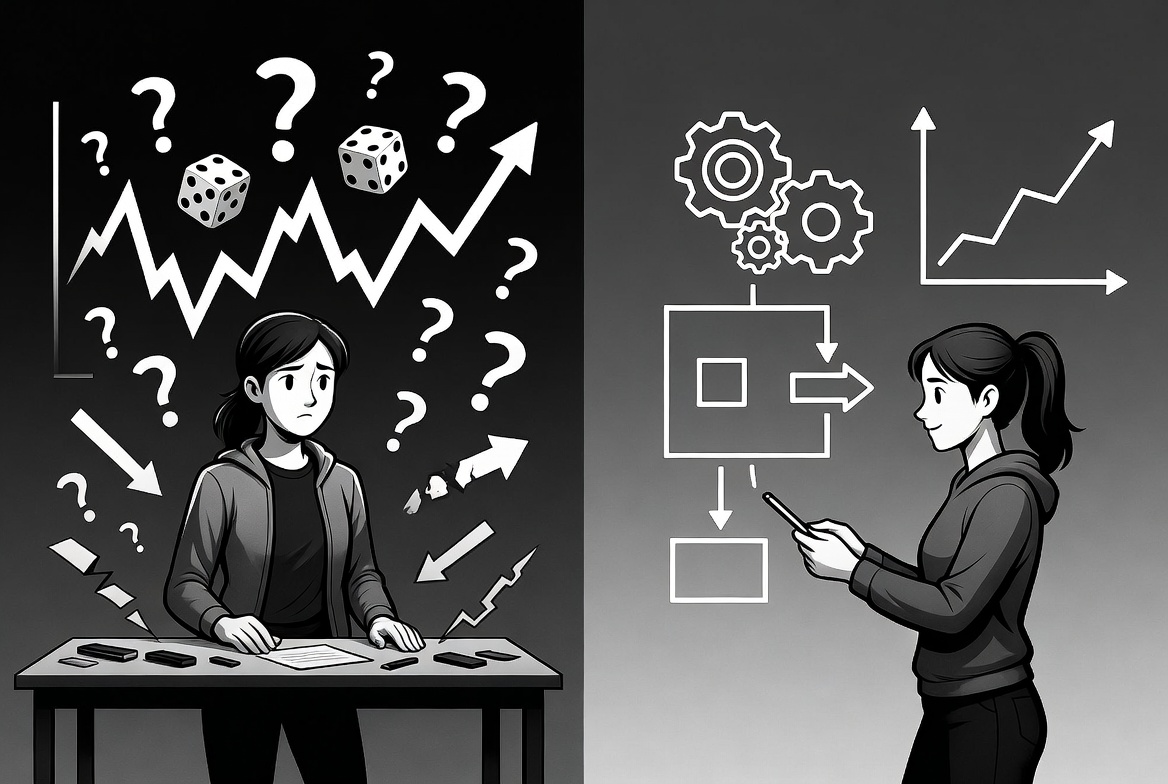
TL;DR
- The market feels random — or rigged. It's neither. Most price moves are driven by a few enormous flows of money that have to move, on a schedule.
- Three flows do most of the work: pension and fund rebalancing, corporate buybacks, and options-dealer hedging.
- These flows create windows where a stock is "in-play" — where institutional money is concentrated and moves get more predictable.
- You don't have to track them yourself. Miiflo scans 8,000+ stocks and ETFs every day to surface what's in-play, so you can act on the same currents institutions do.
You're not imagining it — the game really is tilted
You buy, and it drops. You finally give up and sell, and it rips the next week. You read the news, do the homework, make the sensible call — and the market does the opposite, as if it could see your screen.
It's easy to land on one of two conclusions: the market is random noise, or it's rigged against people like you. After years of that, a lot of investors just stop trying.
Here's the more useful truth: the market isn't random, and it isn't personally out to get you. It's moved by money that has to move — and almost none of that money is ever shown to regular investors.
Price is the footprint of flows
Every price on your screen is just buyers meeting sellers. When one side is bigger than the other, the price moves. Simple.
What's not obvious is who the biggest buyers and sellers are — and that most of them aren't reacting to the news the way you do. Many have no opinion on the stock at all. They're moving billions because a calendar, a mandate, or a hedge requires it. Three flows do most of the heavy lifting.
1. Pension and fund rebalancing
Pension funds, retirement plans, and giant index funds manage trillions of dollars, and they move it on a calendar, not a hunch. To hold their target mix of stocks and bonds, they rebalance at month-end and quarter-end — buying and selling huge amounts simply to hit a number.
On top of that, every single payday a slice of millions of paychecks flows automatically into 401(k)s and index funds. That's a steady, price-insensitive bid — it buys no matter what the headlines say. Mechanical, scheduled demand that has nothing to do with whether the news is good.
2. Corporate buybacks
A buyback is when a company uses its own cash to buy its own shares off the market, which supports the price. For years, corporations have been the single largest buyer of U.S. stocks — bigger than pension funds, bigger than foreign investors.
But buybacks switch off. In the weeks around each earnings report, companies enter a blackout — a self-imposed window where they're not allowed to buy their own stock. When the biggest buyer in the market steps away, the bid underneath the stock thins out. The same kind of news that did nothing last month can suddenly send the stock sliding — not because the story changed, but because the buyer left.
3. Options-dealer hedging
When big institutions buy and sell options, someone has to take the other side of those orders — the market makers, or dealers. Dealers don't want a bet on direction; they want the fee for making the market. So every time they take the other side of an options position, they buy or sell the underlying stock to stay neutral.
That hedging is itself a flow. When dealers are positioned one way, their hedging quietly absorbs moves and pins the stock in place. When they flip the other way, the same hedging pours fuel on a move and makes it bigger. This activity clusters around monthly options expiration — the third Friday of each month — which is one reason certain dates seem to move on a near-schedule.
How the flows show up as "market behavior"
Once you can see the flows, a lot of "random" behavior turns into rhythm:
- Stocks grind higher for weeks on no real news. Buyback and paycheck flows are simply buying, day after day.
- Volatility spikes around earnings season. Buyback blackouts pull the bid away right as dealer hedging flips — two flows reversing at once.
- The last days of a quarter move on cue. Pensions are rebalancing trillions to hit their targets, regardless of the headlines.
None of this requires predicting the future. It just requires knowing whose money has to move, and when.
The plan: stop guessing, start reading flow
You don't need a Bloomberg terminal or a team of quants. The shift is in how you look:
- Treat price as flow, not just news. Ask "who has to be buying or selling here?" before you ask "what's the story?"
- Look for what's in-play. The opportunities live in the handful of names where institutional flow is concentrated — not the whole market, just the ones actually in motion.
- Act where flow and structure line up. When a stock is in-play, that's when a defined-risk position has the wind at its back.
This is the job Miiflo does for you. We scan 8,000+ stocks and ETFs every day and surface the ones that are in-play — so you're choosing from where the money already is, instead of searching the whole haystack yourself.
What it costs to ignore the flows
If you treat the market as random, you end up working against currents you can't see — buying just as a buyback blackout removes the bid, or selling into mechanical end-of-quarter demand. You stay a price-taker, reacting to a story while the real movers act on a schedule you were never shown.
From "it's rigged" to reading the currents
Here's the shift. The market stops being a casino that's out to get you and becomes a system with a logic you can actually see. You stop taking price personally.
You're not predicting the future — you're noticing which way the biggest money is already required to move, and positioning with it instead of against it. That's the edge institutions have always had. It was never a crystal ball. It was just knowing the flows.
See what's in-play — with nothing on the line
Start in paper mode — real market data, zero real money. Miiflo's daily flow surfaces the stocks that are in-play, and the FlowScore helps you compare them. Once you've found where the flow is, defined risk decides how much to put behind it.